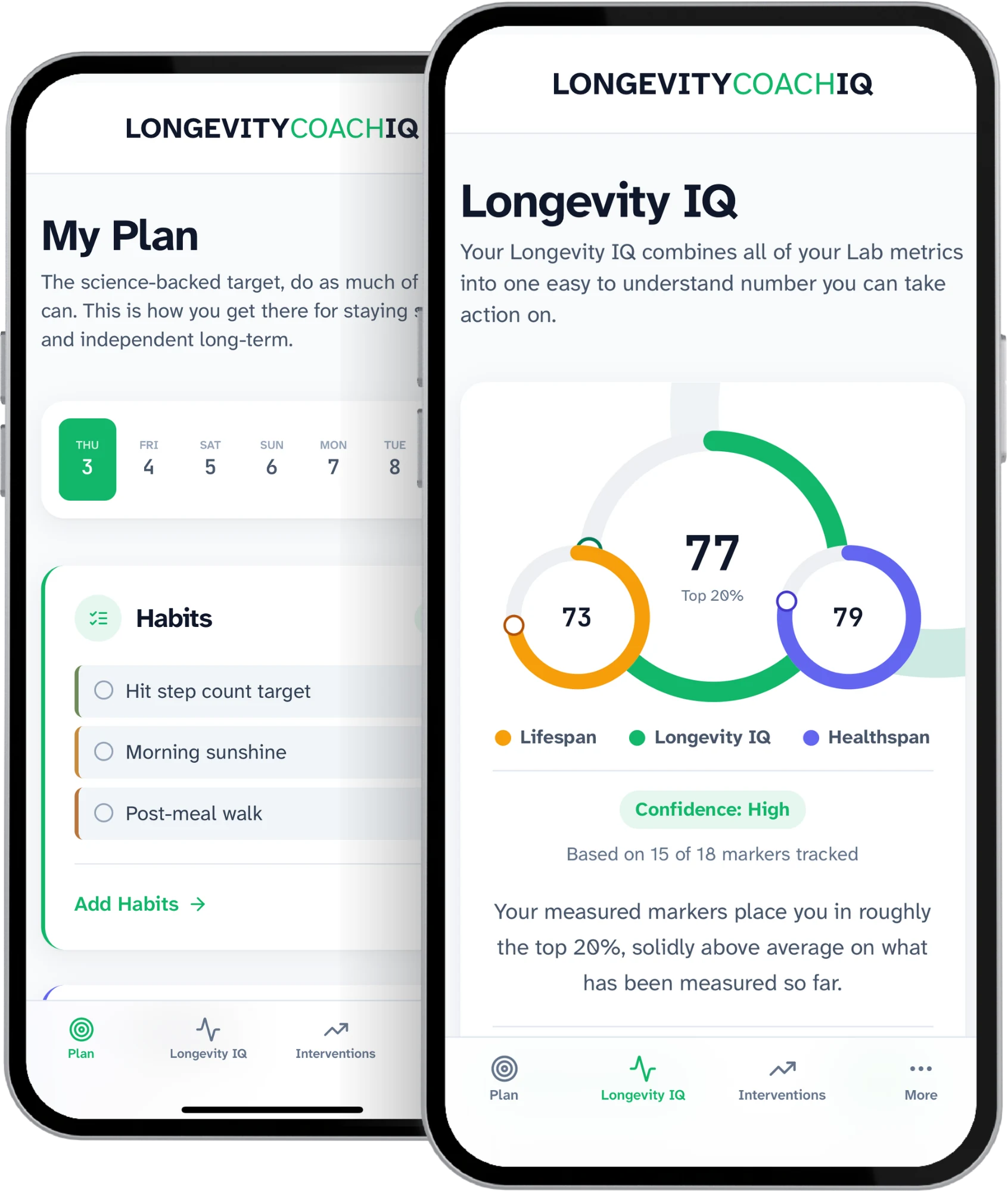
$14.99 a month, against $300 to $600 for a human longevity coach. Every weighting and threshold is published in the methodology.
Get your Longevity IQ in two minutes, with just a tape measure
No lab visit, no medical jargon and no two-hour gym routine. A clear picture of where your health sits today, and the specific next thing to do about it.
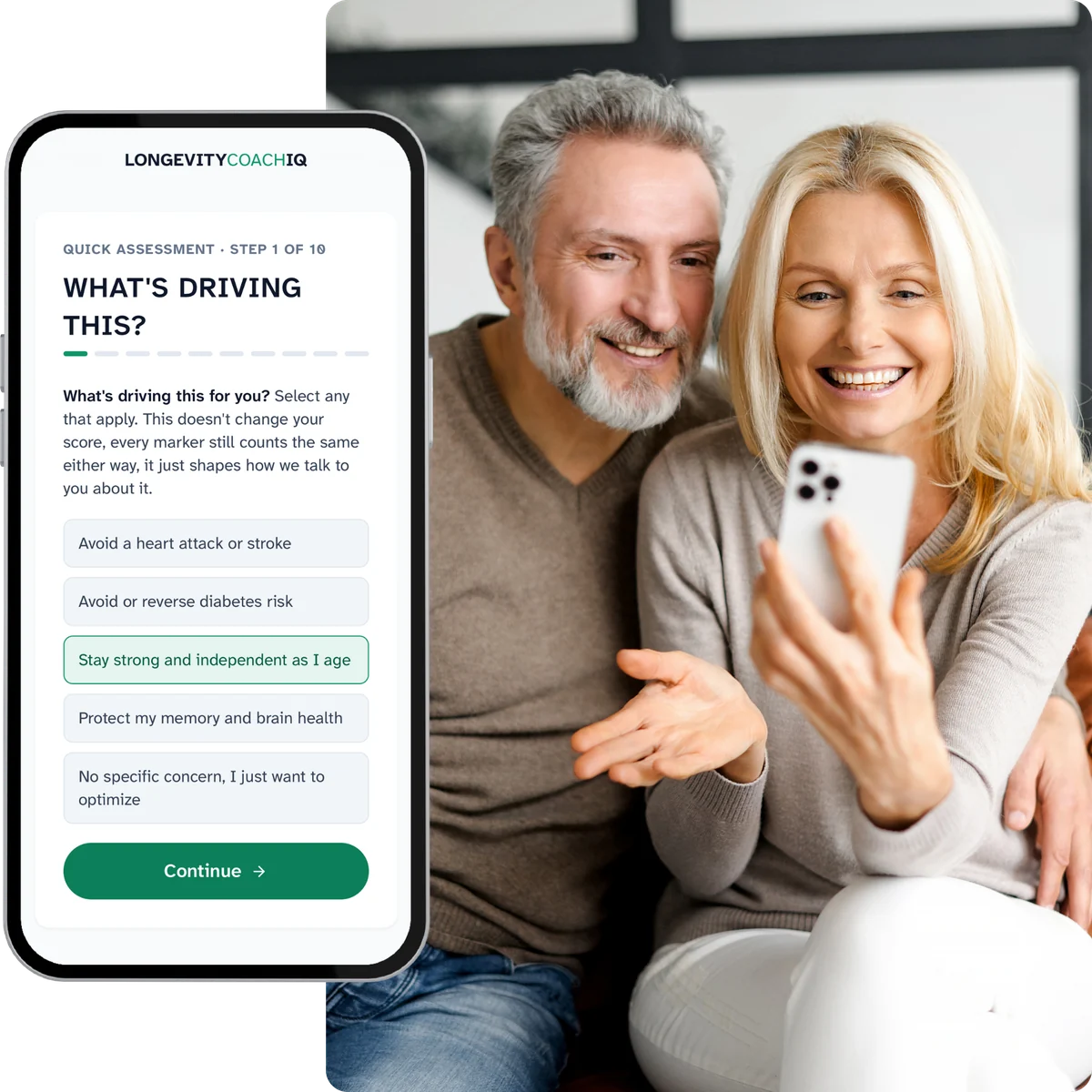
See which part of you is ageing fastest
Answer questions you already know the answers to. Waist size, sleep, a thirty-second movement check, and recent blood results if you have them.
- Four of the six need no blood test. Body Composition, Cardiovascular Health, Compound Strength and Functional Capacity come from a tape measure, a floor and a bar to hang from.
- A missing test never counts against you. If you have no blood results, the two domains that need them sit out, and the badge on your score says which ones.
- You can add blood results later. A fasting panel from a routine check-up unlocks Metabolic Health, and a fuller one unlocks Systemic Health. You do not need to order anything specially.
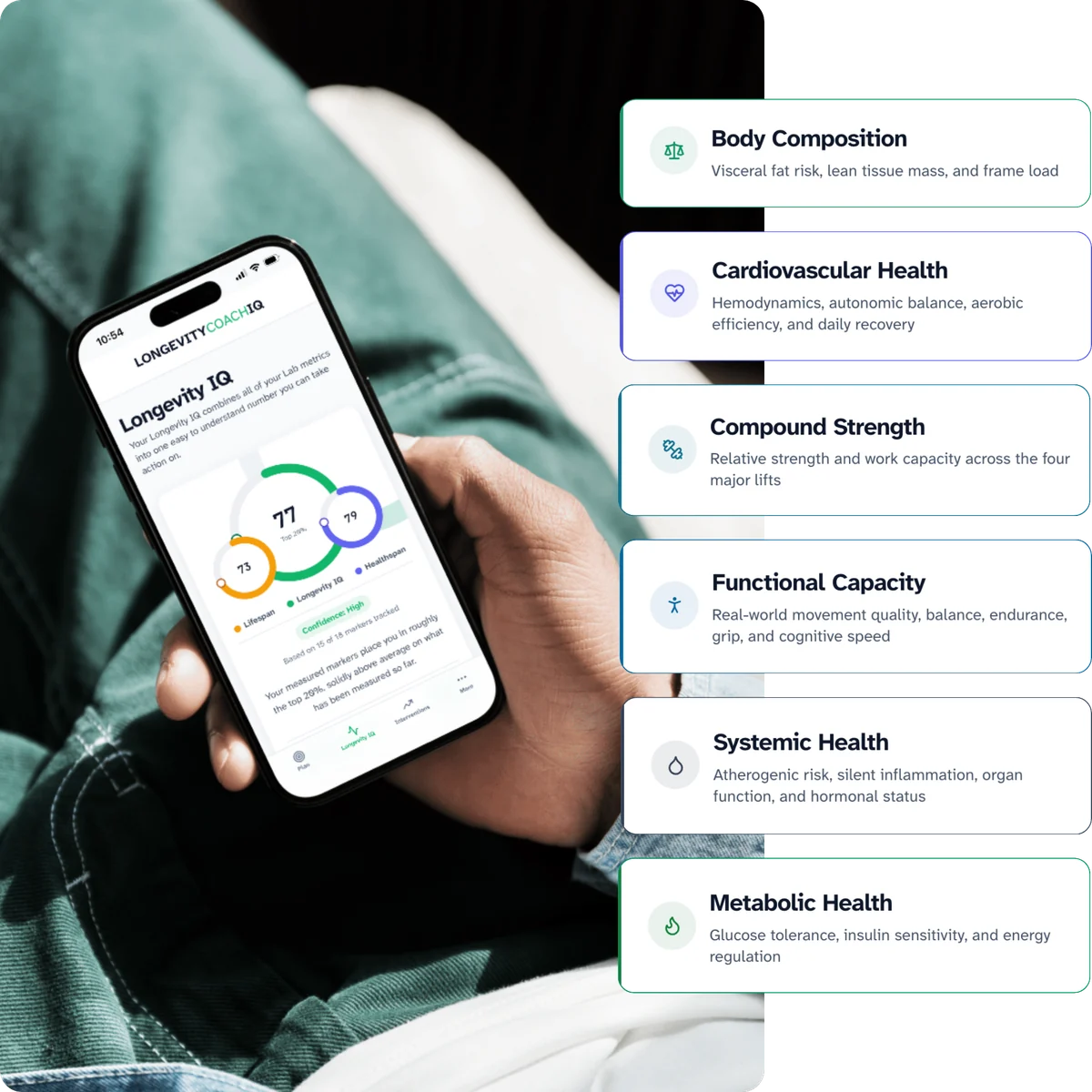
The app scores six areas and tells you which one to fix first
Every marker rolls into one Longevity IQ out of 100, scored against published standards for your age and sex.
- The app names your weakest area. You get a ranking rather than a list of everything you could improve, with the one worth starting on at the top.
- You get two scores, not one. A Healthspan and a Lifespan score sit either side of your overall number, and they often disagree. The distinction is explained here.
- The app will not predict your lifespan. Anyone putting a decimal place on that is guessing. The score tells you which of the two is weaker, and what moves it.
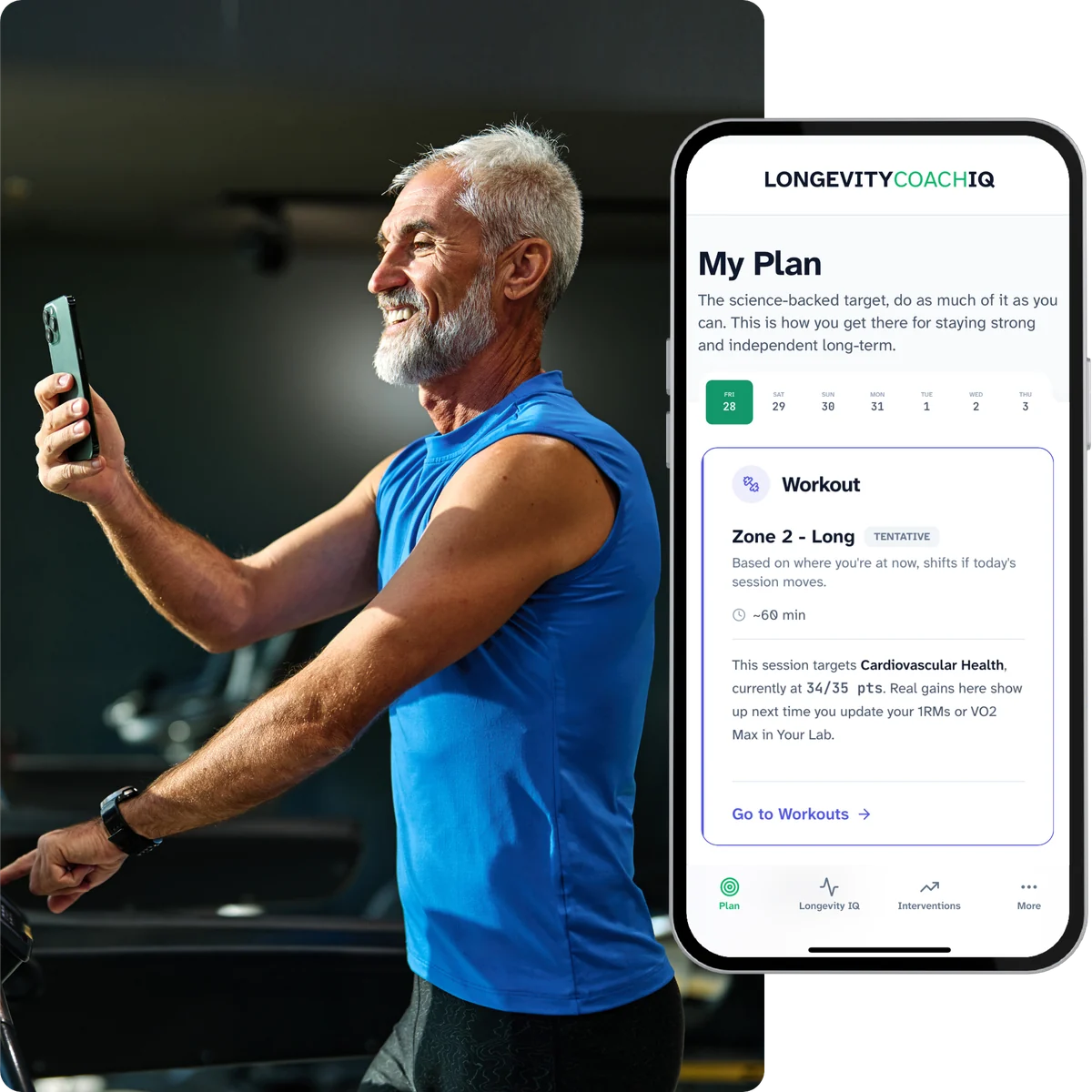
Follow a plan that survives a missed week
Most people arriving here have started something before and stopped. The programme is built around that.
- There is no streak to lose. Miss a week and nothing breaks, and there is nothing to catch up on.
- The sessions that matter most get flagged. When your strength or VO2 max is low, the sessions targeting it are marked high priority, so a short week still has a right answer.
- Rest days do not count against you. A workout habit can run five days a week while a supplement runs seven, so your completion rate reflects what you actually agreed to do.
Longevity coaching is four jobs. Get all four in one app.
Strip away the branding and a longevity coach does the same four things in the same order, whether they charge $400 a month or nothing at all. The question worth asking about any of them is how many of the four they actually finish.
Measure
Get real numbers rather than asking how you feel. Waist, resting heart rate, grip, a sit-to-stand, and bloodwork if you have it. Trackers stop here.
Benchmark
Compare those numbers against people your own age and sex, using published data. Not against your last reading, and not against a reference range wide enough to hold almost everybody.
Prioritize
Decide which single marker is most worth moving, and say what to leave alone. This is the job that needs judgement, and it is the one almost nothing does. Our encyclopedia is where that judgement is on show for free, including the supplement entries that conclude a popular product is not worth buying.
Program
Turn that decision into what you lift on Tuesday, how far you walk on Thursday, and what your protein target is. Advice you cannot execute is not coaching.
Compare longevity coaching to a trainer, a clinic or doing it yourself
Every one of these is a reasonable choice for somebody. This is an honest account of what each does well, including the ones we are not.
Doing it yourself belongs on the list too. The information is largely out there and much of it is accurate, and a motivated person can assemble a reasonable programme from it. What free sources give you is eleven credible answers to eleven separate questions, and no way to rank them against each other, for you, at your age.
| A human longevity coach$300–600 / month | A longevity clinic$500–5,000 first assessment | A wellness app or ring$0–30 / month | Longevity Coach IQ$14.99 / month | |
|---|---|---|---|---|
| Benchmarks you against your own age and sex | Depends entirely on the coach | Yes | Rarely, and usually against an invented point system | Yes, against published percentile data |
| Tells you what to ignore | Sometimes | No, you get everything | No, you get a daily checklist | Yes, markers already in range are hidden |
| Comes with a training program | Usually, and often a good one | No | Sometimes, generic | Sixteen periodized weeks, rebuilt around your weakest domain |
| Available at 6am on a Tuesday | No | No | Yes | Yes |
| Shows you how the number was calculated | Rarely written down | Partly, in the report | Almost never | Every weighting and threshold, published |
| Makes money if you buy supplements | Often | Sometimes | Often | Never. Nothing is for sale |
| Can examine you, diagnose, or prescribe | No | Yes, and this is the real reason to go | No | No, and it will tell you when to see someone who can |
The honest summary. If you want someone to physically examine you and order tests, go to a clinic. If you want a person in the room holding you accountable, hire a coach and enjoy it. Most people reading this are doing it themselves from podcasts and articles, which is free and mostly accurate, and gives you a good answer on protein, a good answer on Zone 2 and no way to rank the two. That is a ranking problem, and it is the one this solves.
No concerns today.
Inside a range wide enough to hold almost everybody. A single marker sitting in range is the most common reason people are told they are fine.
Start with blood pressure.
The same blood pressure reading, now at the 41st percentile for your age and sex. Not one of these is alarming alone. Together they point the same way, and the one most worth moving first gets named.
Get a longevity plan, not another dashboard
Most wellness apps invent a number out of thin air, show it to you every morning and leave the interpretation to you. That is measurement, not coaching. The difference is whether anything tells you what to do next.
- Know which one to do first. If building leg strength protects your joints faster than changing your diet does, you find that out on day one instead of working it out over a year.
- Get a number that means something. Every marker is scored against published research for people your age and sex, with every weighting written down so you can disagree with it.
- Logging takes thirty seconds a day. Tick off what you actually did, and the rest of the week adjusts to how it is going rather than to how you hoped it would go.
Look up any marker, workout or supplement in plain English
You do not need a medical degree or four hours of podcasts. Clear two-minute breakdowns, free to read, with the sources named and no account required.
Browse the encyclopediaTraining
What actually protects you after fifty, and why the easy work matters most.
Nutrition
Protein targets that rise with age, and why the split matters more than the total.
Supplements
What has human clinical backing, and what is marketing.
Habits and blood markers
The daily things that move a number, and the markers worth measuring.
See what ten years of this is actually worth
Most longevity products sell a miracle. This shows you the research-backed gap between staying consistent and doing nothing, which is smaller than the marketing claims and considerably more motivating for being true.
Where published clinical research exists, on age-related strength decline, blood pressure and cardiorespiratory fitness, your trajectory maps directly to it. Where the research is still thin, the app uses a conservative estimate and tells you it is doing so, so you always know which kind of number you are looking at.
How the projections work →Who this is for, and who it is not for
This is for you if
- The things that used to work have quietly stopped working.
- You have had a check-up, been told you are fine, and did not entirely believe it.
- You are watching someone a generation ahead of you lose their independence, and you would rather not repeat it.
- You want to know what the evidence says, including where it is thin.
- You would rather have one number that moves than forty charts that mean nothing.
This is not for you if
- You want a diagnosis or a prescription. That is a doctor's job and the app will keep saying so.
- You want a human being to text you on a Sunday night. Hire a coach, and enjoy having one.
- You want the number to go up without changing anything you do.
- You want to be told a supplement will fix it. Several are graded as showing no effect.
Before you start
What does a longevity coach actually do?
Four things. Measures real markers rather than asking how you feel. Benchmarks them against people of your age and sex. Decides which single marker is most worth improving. Then turns that decision into what you do on Tuesday morning. Most tools do the first job and stop.
How much does longevity coaching cost?
A human longevity coach typically runs $300 to $600 a month, and a first assessment at a longevity clinic runs from about $500 to $5,000 depending on how much clinician time is included. Longevity Coach IQ is $14.99 a month or $89.99 a year, with a seven-day free trial.
Do I need bloodwork to get started?
No. Body Composition, Cardiovascular Health, Compound Strength and Functional Capacity all score without any blood data, using measurements you can take with a tape measure, a floor and a bar to hang from. Metabolic Health unlocks with a standard fasting panel and Systemic Health with a fuller one, both optional upgrades rather than requirements.
Is this actually different from a generic wellness score?
Yes. Every marker is scored against published percentile data for your specific age and sex, not an arbitrary point system. The app also tells you directly which projections are based on cited research versus its own conservative estimate.
Is longevity coaching worth it if I am already reasonably fit?
Reasonably fit people often have the largest single blind spot, because general fitness hides a specific weakness. The score exists to find the one domain sitting well below the others, and it is usually not the one you would have guessed.
Is this too complicated if I'm not already into fitness tracking?
No, that's specifically who it's built for. You start with a few basic numbers, get one simple score, and get told exactly what to do next, no need to already understand percentiles, VO2 Max, or training splits.
How is the workout program different from a generic plan?
It's a periodized sixteen-week program of six sessions and a rest day. When a domain like strength or VO2 max is lagging, the sessions that address it are marked high priority, so on a week where you only manage three you know which three were worth doing.
Is the encyclopedia free, or part of the paid plan?
Free to browse for anyone. It exists to be a genuinely useful reference on its own, not just a funnel into the subscription.