The longevity app that engineers your workout, habit, and supplement protocol
Enter a waist measurement, a set you have already done, and a fasting panel if you have one. Six areas of your health get scored against people your own age and sex, the weakest gets named, and everything downstream rebuilds around it: sixteen weeks of training with the weights worked out, a daily habit list drawn from the markers you are behind on, and a supplement shortlist filtered to your own results.
Free baseline in two minutes · no wearable · no bloodwork to start
Your Longevity IQ
72/100
Priority: Cardiovascular Health
Being in the “normal” range on your blood tests just means you’re aging like everyone else
Clinical reference ranges are built to catch disease, so they are wide by design. They also widen with age, because they are drawn from a population that is aging too. Sitting inside one tells you that you are not ill yet. It does not tell you how you compare or which way you are heading.
All normal.
One binary, against a range wide enough to hold almost everybody. No sense of margin, no direction of travel, nothing you can act on this week.
41st percentile, men aged 54.
A position, a comparison group and a named next action. Six of these roll into one number you can watch move.
Everything the longevity app does, screen by screen
What each part of the app gives you.
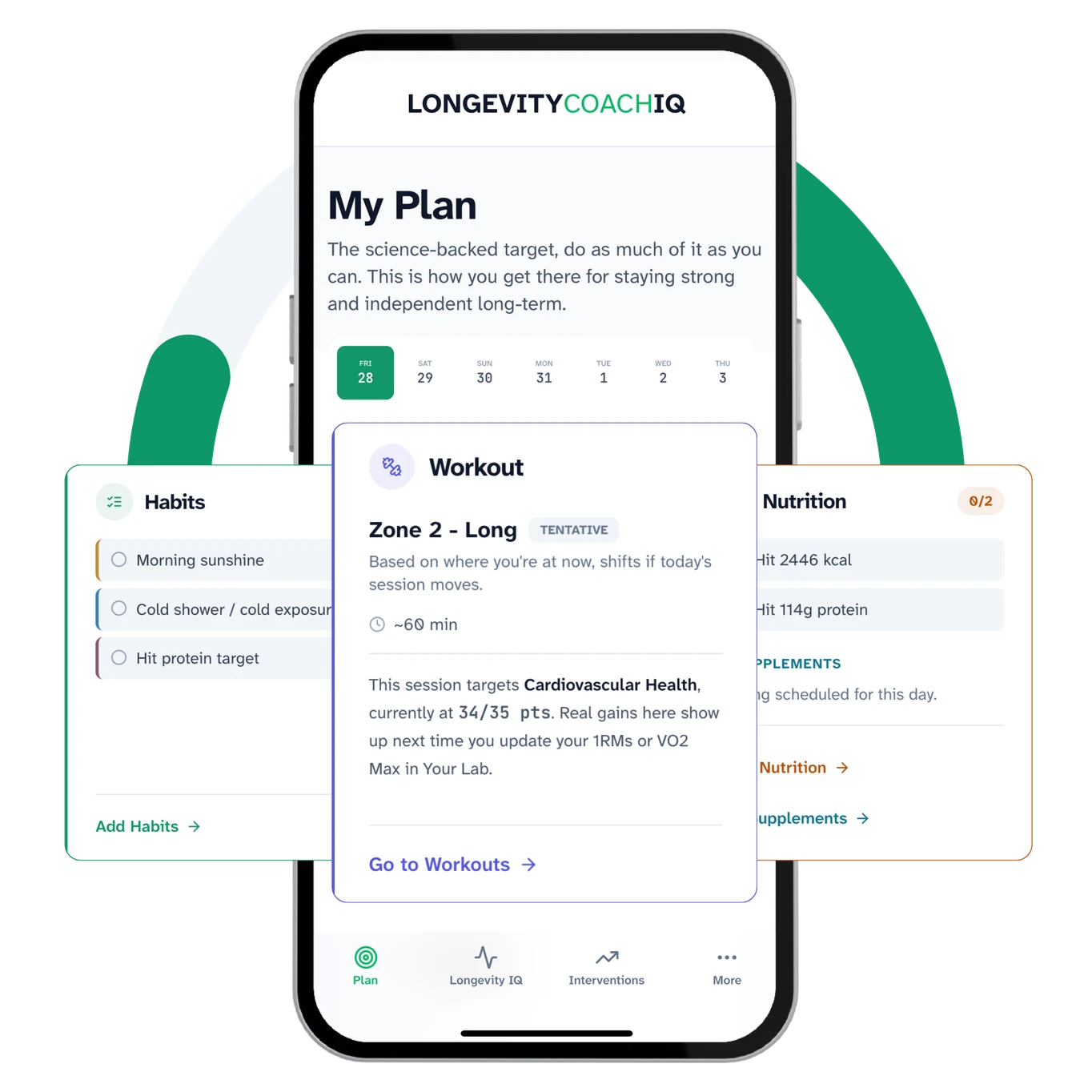
Know what to do this morning without opening a plan
You start with a set already chosen from your family history, your goals and your first results, not the same generic list everyone gets. Beyond that, habits are recommended from the markers you are behind on, and each carries a target, a plain-language reason it matters and the evidence behind it, so adding one is a decision rather than a guess.
- You are not marked down for rest days. A workout habit can run five days a week while a supplement runs seven, so your completion rate reflects what you actually agreed to do.
- You never work out your own protein target. It comes from your bodyweight, and it goes up after 65 instead of sitting where it was at 40.
- Four habits carry no claim at all. Hydration, social connection and purpose are worth doing and too diffuse to honestly pin on one marker, so nothing pretends otherwise.
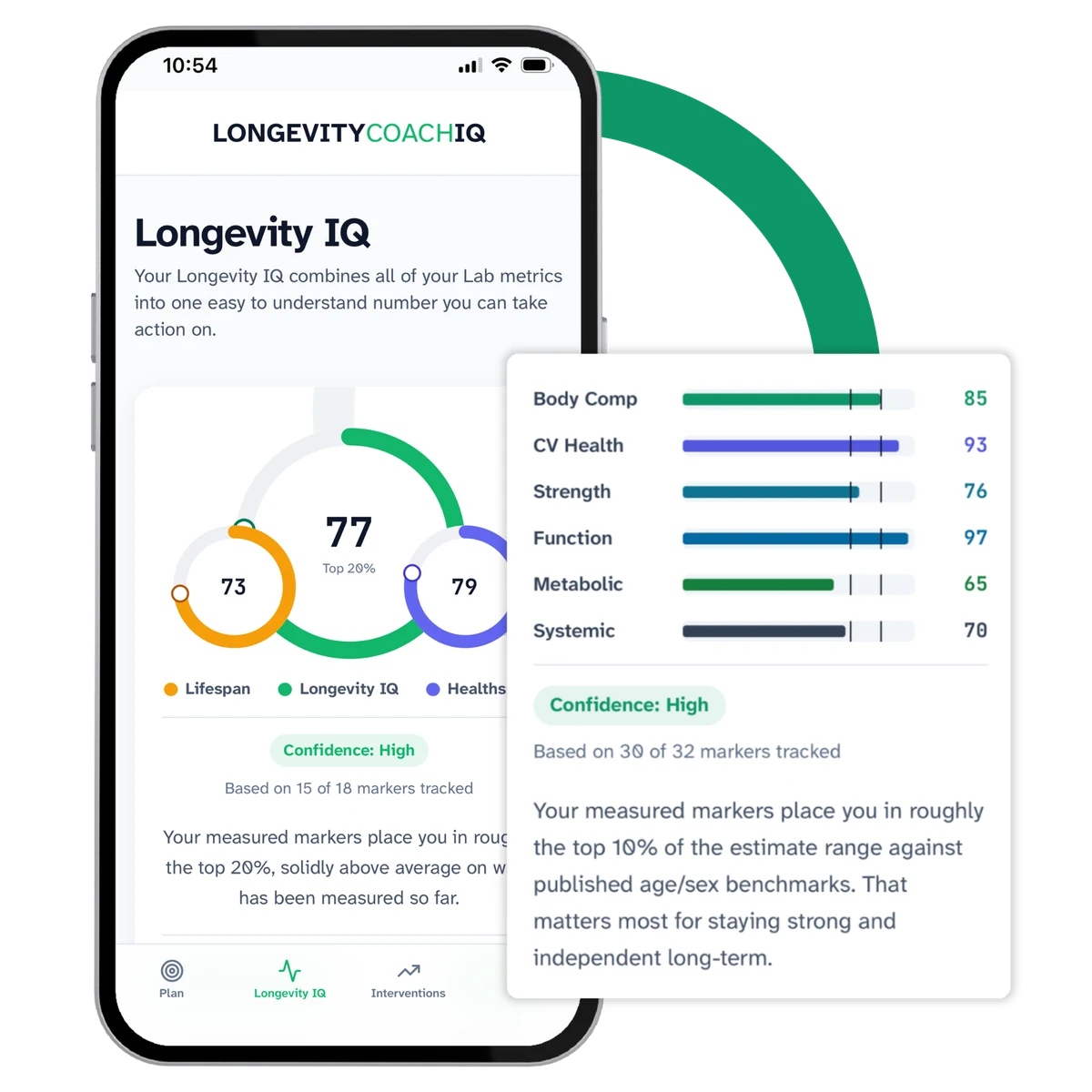
Get one score instead of forty readouts
Most health dashboards hand you forty readouts and no conclusion. You leave knowing more and understanding less. This gives you one score out of 100 and shows the arithmetic underneath it.
- You get two scores, not one. A Healthspan and a Lifespan score sit either side of your overall number, so you can tell which one is dragging.
- Know how much to trust the number. A confidence rating and a count of what you have tracked, so you are not acting on a score built from three data points.
- Argue with it if you disagree. Every weighting and threshold is published, so you can check the arithmetic rather than take it on faith.
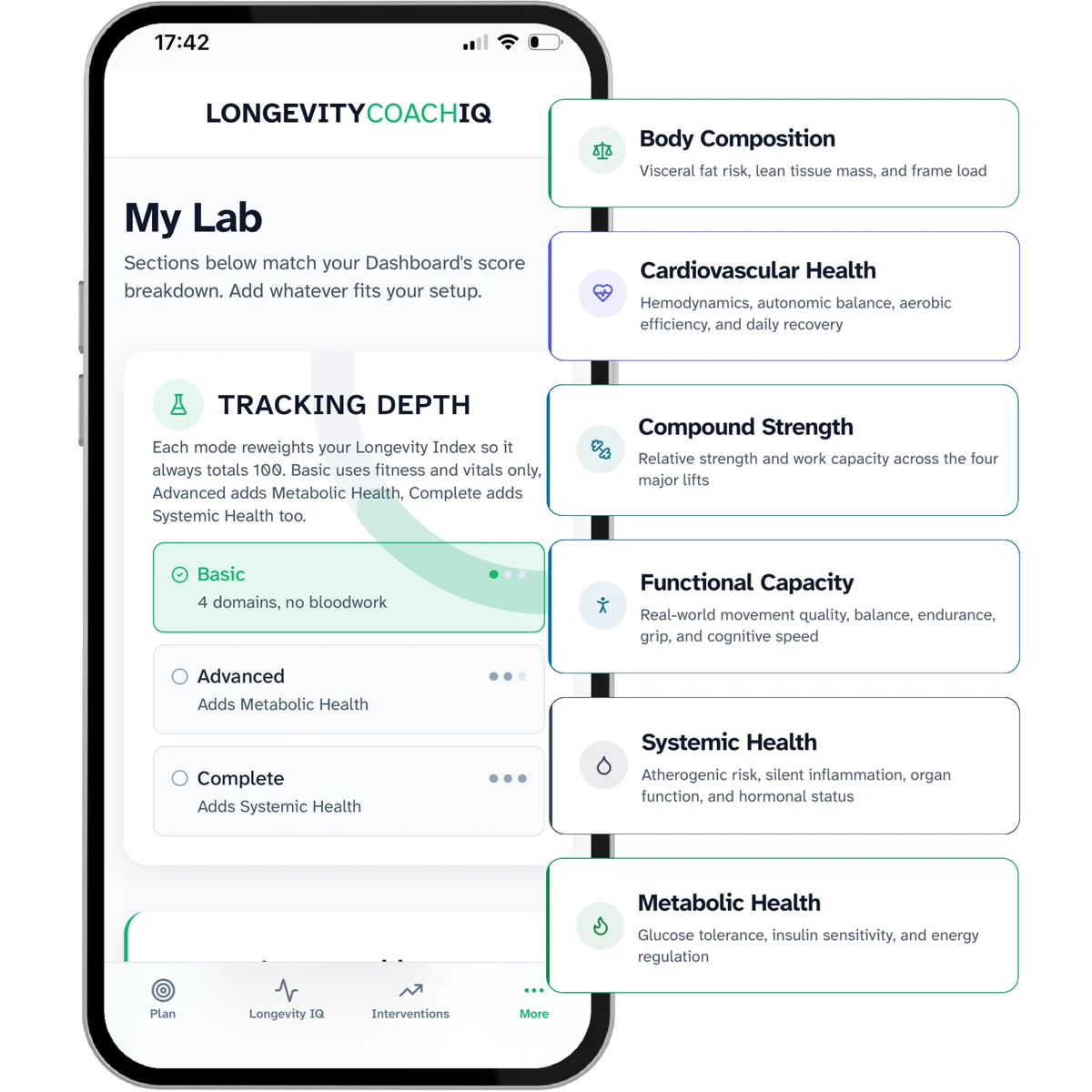
Enter a result once and everything downstream updates
Bloodwork, strength tests and body composition live in one place, and every other screen reads from it. Put in a new squat 1RM and your prescribed weights, your habit recommendations and your score all move without you re-entering anything.
- Get compared against people your own size. Strength standards are worked out for what you actually weigh rather than rounded into the nearest bracket.
- Skip the one-rep max test. A set you have already done is enough to work it out, and anything estimated is labelled as an estimate rather than passed off as tested.
- You are not scored on getting ever-leaner. Body fat scores best at the fitness threshold rather than rewarding lower and lower, because that is where the evidence stops.
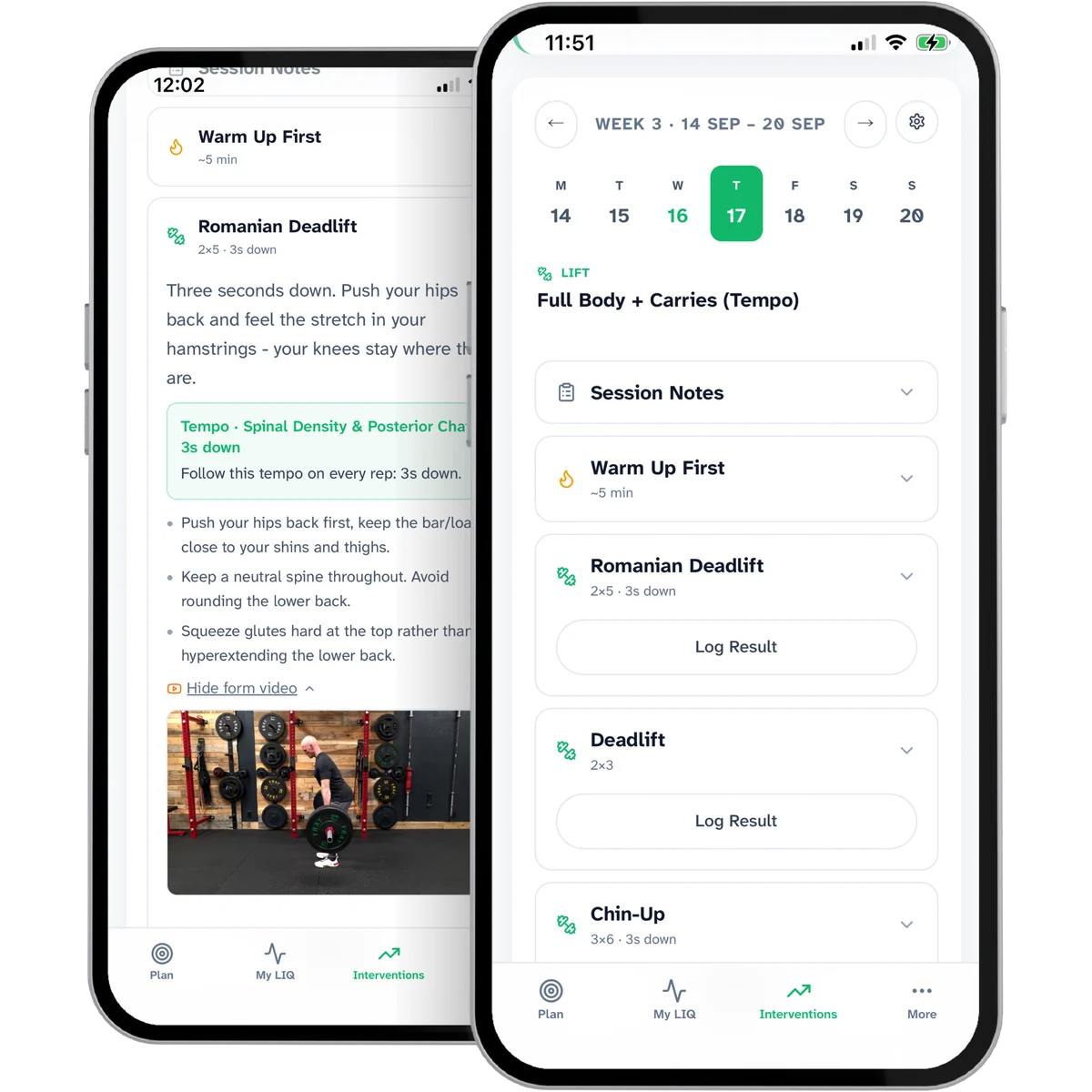
The complete, science backed longevity workout protocol in your pocket
There is so much longevity exercise science out there that it can be hard to know which plan to follow. The Longevity Coach IQ workout fixes that by taking the latest research on exercise protocols and combining it into one simple sixteen-week plan.
- Workouts that adapt to your weaknesses. Behind on strength and a third lifting day appears. Behind on VO2 max and a Zone 2 session becomes intervals.
- Start lifting heavy without getting hurt. The first four weeks build tendon resilience with slow lowers, before anything heavy is asked of you.
- A short week still has a right answer. When strength or VO2 max is low, the sessions targeting it are marked high priority, so you know which ones to keep when only three of the six happen.
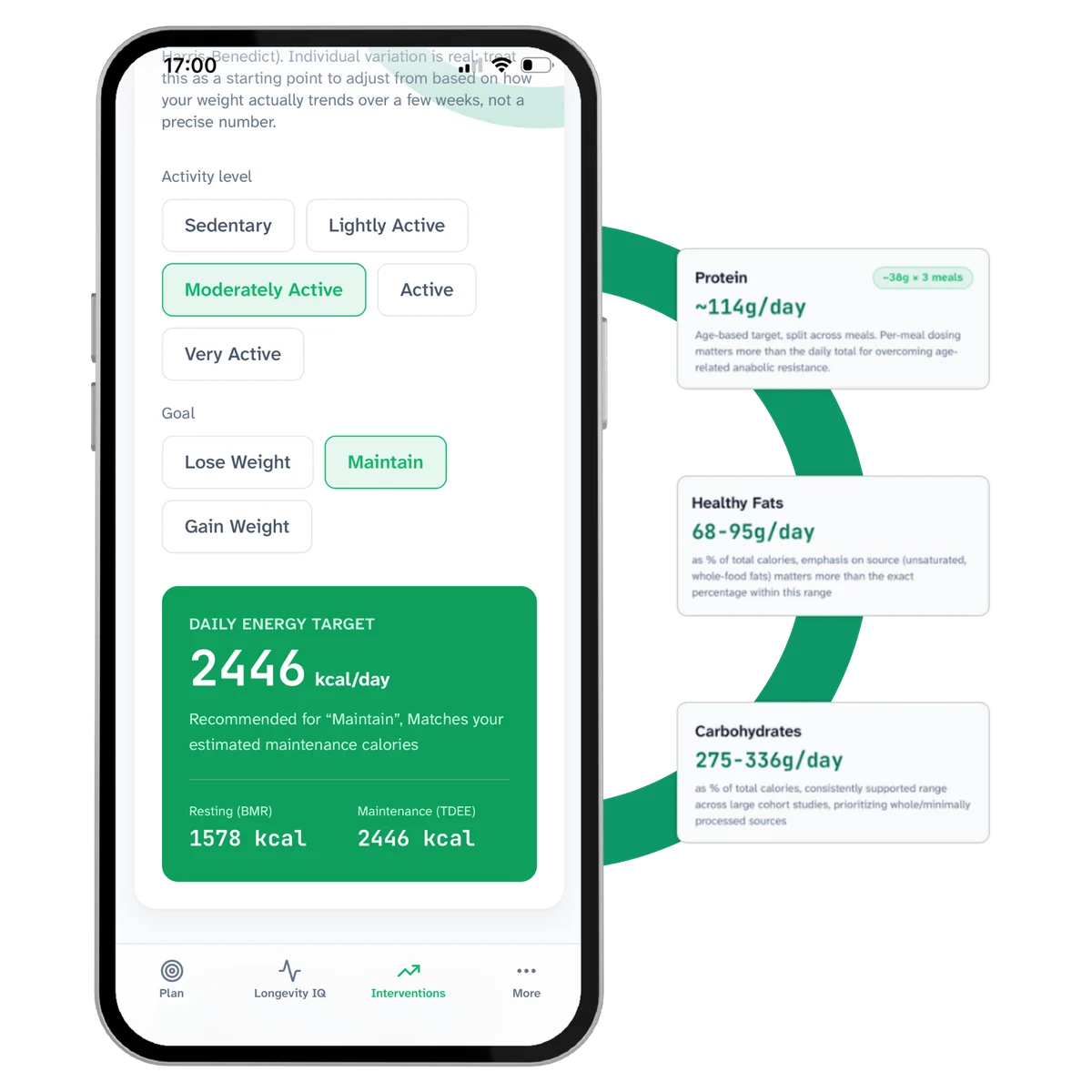
Get your calorie and protein numbers without doing the maths
Set how active you are and what you are trying to do. Calories come from the Mifflin-St Jeor equation applied to your own weight, height, age and sex, then adjusted for your goal. Both toggles save themselves, so there is no form to fill in and nothing to submit.
- Eat enough protein for the age you are. The target rises after 65 and again while you are losing weight, then splits across your meals, because how much you get in one sitting matters more than the daily total once you are older.
- Stop deciding your own macro split. Carbohydrate, fat and fibre arrive as ranges wide enough to hit without weighing everything, so there is still room to eat like a person.
- Stop trying to beat your own target. Going over scores no higher. The one study that would justify pushing past it did not control for how much people exercised, so it is not used.
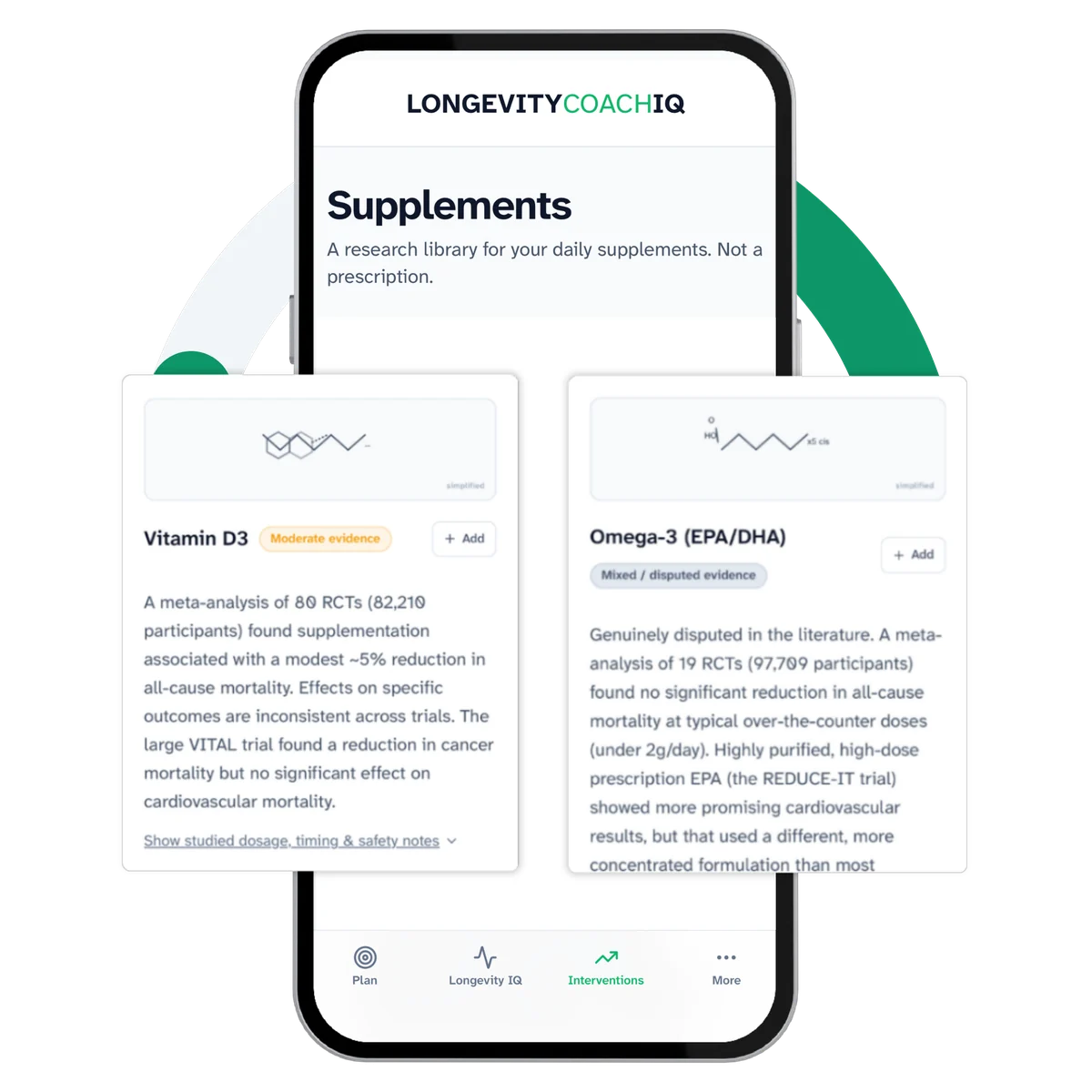
Find out which supplements are worth your money
Every entry carries an evidence tier, the dose the studies actually used, timing and safety notes, and named sources you can go and read. Your own stack sits above the library, with a schedule you can set day by day.
- Know what to stop buying. Supplements shown to do nothing, or to do harm, stay in the library with that on the label rather than quietly disappearing.
- See the dose that was actually studied. Every entry says what the research used, so you can hold it up against what is in the tub. None of them tells you to take anything.
- Only see what applies to you. Vitamin D3 raises a flag only if your own level is under 30, so two people opening the same library get different shortlists.
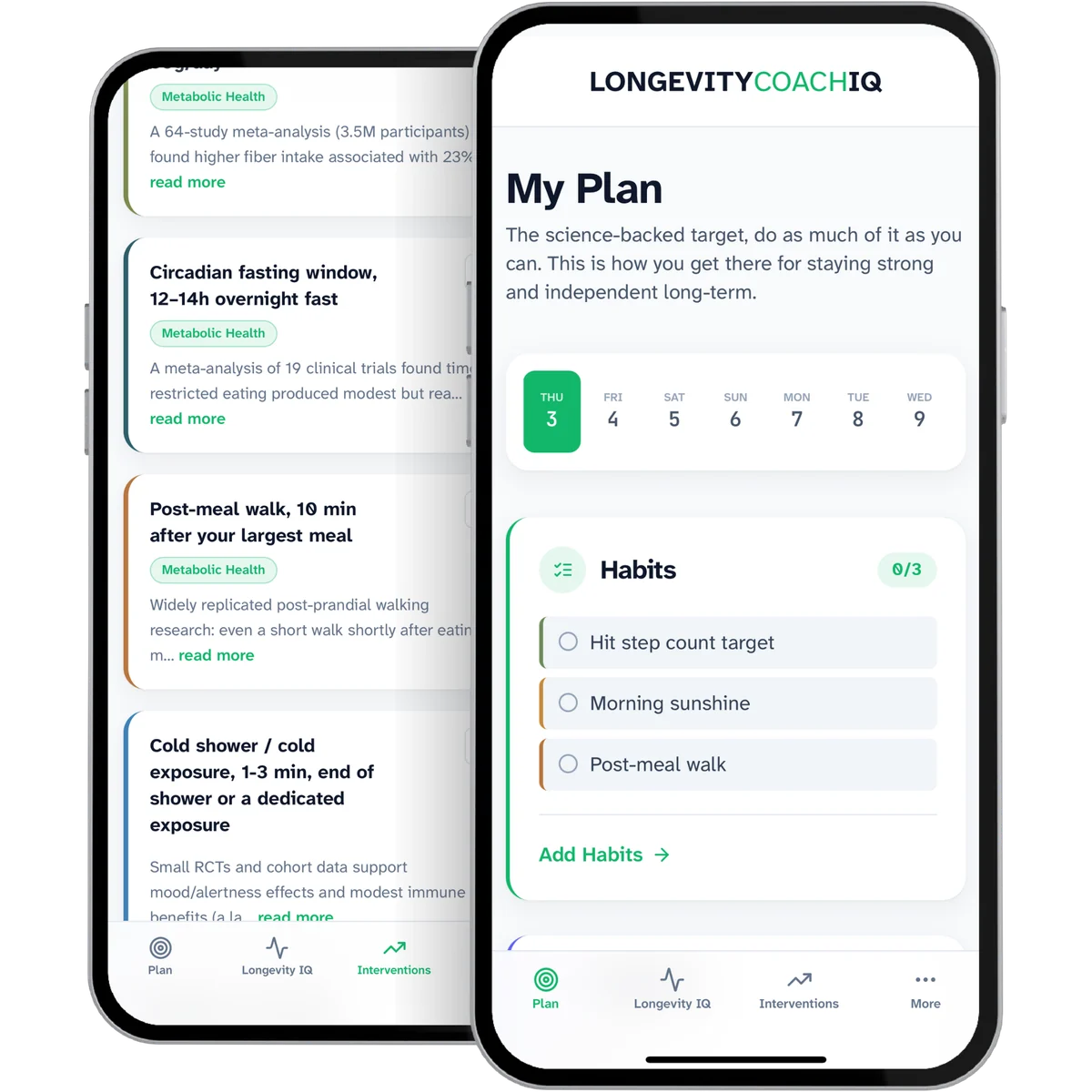
Build the habits your own bloodwork points at
Fourteen habits, each with a target and the source behind it. Which ones carry a recommendation comes from the markers you are actually behind on, and the set changes as your numbers do.
- Get told which habit to start with. Your weakest markers choose them. A high HbA1c brings up post-meal walks, a fasting window and fibre, in that order.
- Know where the target came from. Steps sit at 7,000 to 10,000 a day with the study named on the habit itself, so you can check it rather than take it on trust.
- The app never invents a habit to fill a gap. Four markers, ApoB and Lp(a) among them, get no habit recommendation, because there is no honest one to give.
Start today with a tape measure. Add bloodwork when you want to
Body Composition, Cardiovascular Health, Compound Strength and Functional Capacity all score from measurements you take at home, with a tape measure, a floor and a bar to hang from. Metabolic Health needs a standard fasting panel. Systemic Health needs a fuller one.
| Domain | Basicno equipment | Advancedfasting panel | Completefull panel |
|---|---|---|---|
| Body Composition | yes | yes | yes |
| Cardiovascular Health | yes | yes | yes |
| Compound Strength | yes | yes | yes |
| Functional Capacity | yes | yes | yes |
| Metabolic Health | no— | yes | yes |
| Systemic Health | no— | no— | yes |
Basic covers everything measurable with a tape measure, a floor and a bar to hang from. Advanced adds Metabolic Health from a standard fasting panel of glucose, HbA1c and triglycerides. Complete adds Systemic Health, covering ApoB, hs-CRP, Lp(a), homocysteine and liver markers.
Six things this longevity app will not do
Better you find out on this page than three weeks in.
The app does not diagnose
A percentile tells you where you stand against people your age and sex. A percentile is not a clinical assessment, and it cannot tell you whether you have a condition. A concerning number is a reason to see a doctor, not a substitute for one.
It does not score bone density
Bone matters enormously after 50, and none of the tracked markers reliably predict it, so the app does not pretend otherwise. The training does load the skeleton in the way that protects it, through the tendon block and the progressive loading, even though the score cannot measure the result. The entry explains what actually assesses bone risk instead.
It does not sell supplements
The supplement entries are evidence-graded, and several conclude a popular product is not worth taking. There is nothing to buy here and no affiliate link to follow.
It does not need a wearable
Every marker can be entered by hand. A watch is useful if you already have one, and the app is built so that not owning one costs you nothing.
It does not promise a number of years
Anyone quoting a decimal place on your life expectancy is guessing. Projections are modelled from published research on age-related decline, and where the research does not exist the app says the estimate is its own.
It does not hide the maths
Every weighting, threshold and percentile band is published in the methodology. Go and read it before you pay anything.
That is what it does not do. What it does is tell you where you actually stand, and what to work on next.
Start your 7-day free trial $14.99/month after trial · cancel anytimeCompare this longevity app to a trainer, a clinic or doing it yourself
Each of these is a reasonable choice for somebody. Most people reading this are doing it themselves from podcasts and articles, which is free and mostly accurate. What it cannot give you is a ranking, because no source has seen your numbers.
Doing it yourself
The information is largely out there and much of it is accurate. A motivated person can assemble a reasonable programme from it. What it gives you is eleven credible answers to eleven separate questions, and no way to rank them against each other, for you, at your age.
A personal trainer
Two sessions a week, usually with no view of your bloodwork, no benchmark for your age group and no plan for the five days they do not see you.
A longevity clinic panel
A great deal of data, a consultation and a PDF. Genuinely useful once. It does not tell you what to do next Tuesday and it does not follow up.
Longevity Coach IQ
One score, six domains, a ranked list of what to fix, sixteen weeks of programming and a daily checklist. Seven days free, then one price with nothing held back.
Before you start
Do I need a blood test to use it?
No. Basic tracking covers four of the six domains with no bloodwork at all, using markers you can measure with a tape measure, a floor and a bar to hang from. Advanced and Complete add the domains that need a fasting panel, whenever you get round to it.
What if I have not trained in twenty years?
The program opens with a four-week tendon resilience block precisely because most people arriving here have connective tissue that has not been loaded in a long time. Loads come from your own tested maxes, so week one is calibrated to you rather than to a beginner template.
Does it work with my watch or ring?
Use the numbers off any of them. Nothing in the app requires one and every marker can be typed in by hand, so not owning one costs you nothing.
Will it tell me how long I am going to live?
No, and be wary of anything that says it will. Projections are modelled from published research on age-related decline, and where that research does not exist the app tells you the estimate is its own.
I have a bad knee and a rebuilt shoulder. Is that a problem?
Every loaded exercise has alternatives that preserve the training intent, and equipment access can be switched mid-session. The app is not a physiotherapist though. If something is under active treatment, bring the plan to whoever is treating it.
What happens after the seven days?
$14.99 a month or $89.99 a year, cancel anytime. Seven days free, so you can see your number before deciding anything.
See your score, not a demo of someone else's.
Your starting baseline takes under two minutes. No lab visit, no equipment, and no credit card required.
$14.99 a month, or $89.99 a year. Both start with a 7-day free trial. Full pricing →
Calculate my Longevity IQ →Free instant baseline · start with zero equipment